🚚 Free Worldwide Shipping on All Orders!Shop Now

Lucie Armitt: George Eliot - Adam Bede/The Mill on the Floss/Middlemarch [2000]
George Eliot's reception as a writer has been chequered from the start. Prejudice followed the reluctant revelation of her real identity as a woman, and she suffered from critical neglect at the start of the twentieth century, before a post-war renaissance of interest finally established her as one of the most powerful and accomplished of British novelists. Views of Mary Ann Evans, the woman behind the pseudonym, have always been controversial: castigated during her own time for sexual impropriety with a married man, accused by male 'friends' of being an overly intellectual 'man-woman', rejected by twentieth-century feminists for the opinions expressed in her essay 'Silly Novels by Lady Novelists', she is a figure for our own times as much as for her own.
Focusing on three of Eliot's most influential and widely-read 'Midlands' novels, Lucie Armitt traces the effect of recent critical interpretations upon the reception and teaching of Eliot's work, as well as revisiting some of the perspectives offered by original reviewers and early critics. Class, gender and ideology all come under scrutiny, as do Eliot's central fictive themes of currency, circulation, sensuality and the voice. A variety of theoretical positions are reflected in the material selected for discussion, including post-structuralism, feminism, Marxism and psychoanalysis. Clear explication of these discourses is offered, combined with informative and detailed readings of primary extracts as illustrations.
Focusing on three of Eliot's most influential and widely-read 'Midlands' novels, Lucie Armitt traces the effect of recent critical interpretations upon the reception and teaching of Eliot's work, as well as revisiting some of the perspectives offered by original reviewers and early critics. Class, gender and ideology all come under scrutiny, as do Eliot's central fictive themes of currency, circulation, sensuality and the voice. A variety of theoretical positions are reflected in the material selected for discussion, including post-structuralism, feminism, Marxism and psychoanalysis. Clear explication of these discourses is offered, combined with informative and detailed readings of primary extracts as illustrations.
Product Information
Product Information
Shipping & Returns
Shipping & Returns
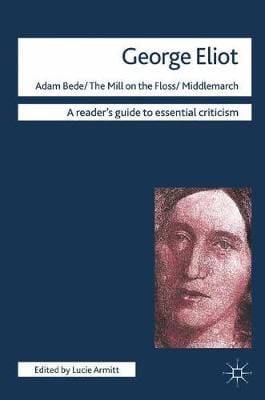
Lucie Armitt: George Eliot - Adam Bede/The Mill on the Floss/Middlemarch [2000]
Lucie Armitt: George Eliot - Adam Bede/The Mill on the Floss/Middlemarch [2000]
George Eliot's reception as a writer has been chequered from the start. Prejudice followed the reluctant revelation of her real identity as a woman, and she suffered from critical neglect at the start of the twentieth century, before a post-war renaissance of interest finally established her as one of the most powerful and accomplished of British novelists. Views of Mary Ann Evans, the woman behind the pseudonym, have always been controversial: castigated during her own time for sexual impropriety with a married man, accused by male 'friends' of being an overly intellectual 'man-woman', rejected by twentieth-century feminists for the opinions expressed in her essay 'Silly Novels by Lady Novelists', she is a figure for our own times as much as for her own.
Focusing on three of Eliot's most influential and widely-read 'Midlands' novels, Lucie Armitt traces the effect of recent critical interpretations upon the reception and teaching of Eliot's work, as well as revisiting some of the perspectives offered by original reviewers and early critics. Class, gender and ideology all come under scrutiny, as do Eliot's central fictive themes of currency, circulation, sensuality and the voice. A variety of theoretical positions are reflected in the material selected for discussion, including post-structuralism, feminism, Marxism and psychoanalysis. Clear explication of these discourses is offered, combined with informative and detailed readings of primary extracts as illustrations.
Focusing on three of Eliot's most influential and widely-read 'Midlands' novels, Lucie Armitt traces the effect of recent critical interpretations upon the reception and teaching of Eliot's work, as well as revisiting some of the perspectives offered by original reviewers and early critics. Class, gender and ideology all come under scrutiny, as do Eliot's central fictive themes of currency, circulation, sensuality and the voice. A variety of theoretical positions are reflected in the material selected for discussion, including post-structuralism, feminism, Marxism and psychoanalysis. Clear explication of these discourses is offered, combined with informative and detailed readings of primary extracts as illustrations.
$1.72
Original: $5.73
-70%Lucie Armitt: George Eliot - Adam Bede/The Mill on the Floss/Middlemarch [2000]—
$5.73
$1.72Product Information
Product Information
Shipping & Returns
Shipping & Returns
Description
George Eliot's reception as a writer has been chequered from the start. Prejudice followed the reluctant revelation of her real identity as a woman, and she suffered from critical neglect at the start of the twentieth century, before a post-war renaissance of interest finally established her as one of the most powerful and accomplished of British novelists. Views of Mary Ann Evans, the woman behind the pseudonym, have always been controversial: castigated during her own time for sexual impropriety with a married man, accused by male 'friends' of being an overly intellectual 'man-woman', rejected by twentieth-century feminists for the opinions expressed in her essay 'Silly Novels by Lady Novelists', she is a figure for our own times as much as for her own.
Focusing on three of Eliot's most influential and widely-read 'Midlands' novels, Lucie Armitt traces the effect of recent critical interpretations upon the reception and teaching of Eliot's work, as well as revisiting some of the perspectives offered by original reviewers and early critics. Class, gender and ideology all come under scrutiny, as do Eliot's central fictive themes of currency, circulation, sensuality and the voice. A variety of theoretical positions are reflected in the material selected for discussion, including post-structuralism, feminism, Marxism and psychoanalysis. Clear explication of these discourses is offered, combined with informative and detailed readings of primary extracts as illustrations.
Focusing on three of Eliot's most influential and widely-read 'Midlands' novels, Lucie Armitt traces the effect of recent critical interpretations upon the reception and teaching of Eliot's work, as well as revisiting some of the perspectives offered by original reviewers and early critics. Class, gender and ideology all come under scrutiny, as do Eliot's central fictive themes of currency, circulation, sensuality and the voice. A variety of theoretical positions are reflected in the material selected for discussion, including post-structuralism, feminism, Marxism and psychoanalysis. Clear explication of these discourses is offered, combined with informative and detailed readings of primary extracts as illustrations.